Senator David Norris' address to Seanad Eireann (the Irish Senate)

In Sept. 2007, fourteen months before Ireland's bank bailout, I resigned from my position as the Risk Manager of UniCredit Bank Ireland. I did that in order not to incriminate myself. I have spent the last 4 years seeking justice. On Feb. 23rd., 2010, I was fortunate to have Senator David Norris raise the matter in Seanad Eireann (the Irish Senate), and request a response from the Minister of Finance, Mr. Brian Lenihan. Senator Norris concluded by stating that:
"...there is ministerial responsibility in this matter. This is a grossly serious matter which has been reported to the Financial Regulator. A man has lost his job as a result. He honourably resigned. The degree of breach was 40 times the accepted margin. This is a disaster. If we are not prepared to face the issue and investigate it when it has been laid before the House, there is absolutely no hope for the financial system or its reputation worldwide...How can the Financial Regulator investigate himself? He was in breach of his responsibility."
http://debates.oireachtas.ie/seanad/2010/02/23/00012.asp
In Nov. 2011, Emma Alberici, Europe correspondent for ABC TV, told my story as part of her documentary 'Going Rogue' which featured Nick Leeson and Sir John Vickers among other interviewees. It is ironic that at a time when the Irish tax-payer is bailing out un-secured bond holders, my story which occurred in Dublin, is deemed of interest to the Australian TV license payer. Please click on 'play video' on the following link:
http://www.abc.net.au/foreign/content/2011/s3367080.htm
VRT, Belgian state-TV, aired this interview with me on March 6th., 2013. My Interview begins in minute 27:
Het verdriet van Europa: Zeepbellen blazen (The sadness of Europe: Bursting bubbles)
VRT, Belgian state-TV, released extra footage of my interview on March 8th., 2013. (in English):
Whistleblower.IRL@gmail.com

Monday, 25 March 2013

Further info re Ireland, Depfa and Hypo Real Estate


Further to recent comments I made on Twitter regarding the silence of Dublin & Berlin about what German banks got up to in the IFSC [Irish Financial Services Centre], I have received a number of emails asking for further information. My response to these emails is to simply quote a sub-article of the article that was written about me by Fintan O'Toole in the Irish Times. The article was published on Saturday, 3 April, 2010. 

-----------------------------------------------------------------------------
The finance manager who tried to play by the rules 
- Fintan O'Toole, Irish Times, Saturday, 3 April, 2010
The experience of this former IFSC banker is a parable of Celtic Tiger Ireland, illustrating the culture of light touch regulation that led the country to NAMA and bank bailouts....

Light Regulation: The lure of the IFSC
Catastrophic as this week's [Irish, JS] banking bailout figures are, they could actually have been much worse. It is a matter of sheer luck that in 2007, before the credit crunch, a Dublin-based bank called Depfa was bought by the German financial group Hypo Real Estate. Very few people in Ireland had ever heard of Depfa. Although it was as German as sauerkraut, it was actually the largest bank in Ireland - bigger than AIB. It was, in legal and regulatory terms, an entirely Irish company. When the financial crisis unfolded, Depfa brought down Hypo. The cost to the German government so far is €102 billion.
The IFSC [Irish Financial Services Centre, JS], where Depfa was based, provides 25,000 jobs, and at its height brought in well over €1 billion a year in taxes. The downside was that, as well as low corporate taxes, part of the attraction for foreign banks was light regulation. And the need to keep these banks sweet reinforced the ultimately disastrous idea that all our regulators should fight in the featherweight division.
Ireland already suffered, as the Dail's [parliament] Dirt inquiry put it, from "a particularly close and inappropriate relationship between banking and the State and its agencies...[who] were perhaps too mindful of the concerns of the banks, and too attentive to their pleas and lobbying".
These lobbies were immensely strengthened by the growth of the IFSC. The problem was that, as well as having many legitimate operations, the IFSC also contained brass-plate tax-avoidance operations that earned it the tittle of 'Liechtenstein on the Liffey' and sharp operators that led the new York Times to label it 'The Wild West of European Finance'. Yet, even after IFSC-based companies were involved in three spectacular frauds - Europe's biggest corporate collapse (Parmalat); a $500 million fraud by the American Insurance Group (AIG); and the largest single collapse in Australian history - there was no attempt to enhance the regulatory regime. Banks like Anglo Irish couldn't be subject to serious regulation without imposing the same rules at the IFSC. And the absolute understanding was that no one at the IFSC was to be given the slightest cause for anxiety.
-----------------------------------------------------------------------------
It is not for me to comment about who brought who down - Depfa, or Hypo Real Estate, but I do recommend reading these blog postings by David Malone on his Golem XIV blog:

David McWilliams, an Irish economist, made a very interesting remark when interviewed for German TV (in English)

Sunday, 17 March 2013

Unpleasantness in Belgium, Silence in Ireland. - David Malone, Golem XIV blog, 12 March 2013


A small storm has begun to form in Belgium this morning. The centre of the storm is a comment made on a Belgian television documentary (begins 26 minutes in) by none other than Jonathan Sugarman, AKA WhistleblowerIRL, whom the Village Magazine called the most significant whistleblower in Ireland.

You have to hand it to Sugarman. He has a knack for giving the authorities heartburn. I wrote an update about his case at the time of the Village Magazine piece which filled in a couple of interesting details.

This time he happened to mention as an example of the total lack of financial regulatory oversight in Ireland during the bubble years the Belgian Bank KBC.  As Sugarman said, just this month KBC Belgium had to give KBC Ireland another €100 million in order to bail it out. To illustrate how KBC had got itself into the state where it is still being bailed out by the Belgian tax payer via its parent company, he told how he himself had been given a mortgage by KBC in Ireland. As he said in the interview,

“When I looked at the forms I had to fill in for KBC Ireland, it was a joke. I could have said I was Mickey Mouse and I work in La la land and I would still have a million euro to buy a house with maybe was woth 200 000 euro. Did anybody ask questions. No. The bank is growing. Where’s the problem.”

Where indeed? What he didn’t say in the interview is that the bank did not actually bother to value the property he was buying before it gave him the mortgage. It looked at the house next door and guessed.

So now given the continued bleeding and rotting going on inside KBC as well as the epic implosion of Dexia and the fact that, as in Ireland, no one has been held responsible, there are questions being asked in Belgium that powerful people don’t want asked.

Back in 2010 I wrote an article about the way German banks used Ireland as a dark pit for doing deals they could not do elsewhere. It was called Ireland was Germany’s Off-shore Tart. It seems she was Belgium’s tart too.

What Sugarman’s story reveals above all is how no one in power, whether that be financial, political or media power, wants any questions asked or truths exposed.  Sugarman has been ignored by everyone in the Irish establishment: his bank, the banks regulator, all the Irish political parties, all the newspapers and I was there when he told his story to one of Ireland’s top TV journalists only to never hear from him again.

Sugarman was the risk manager who resigned from Unicredit when his warnings to senior management, that the bank was routinely failing to hold enough capital to protect depositors from a bank run, were being ignored.

Irish law says clearly a breach of the minimum holdings of even 1% must be notified to the regulator immediately. He was finding UniCredit being routinely 19% short. When he asked an independent company to check his figures they told him the breaches were as high as 40%. This means the bank was short billions. Such a shortfall means if there was run on the bank it would not have a hope of surviving.

Sugarman was ignored and told to stop complaining. He resigned.

A month later Northern Rock collapsed when a run on the bank exhausted its cash reserves. A year later the Irish banks collapsed.

You might have thought the Irish Bank regulator would want to know what Sugarman had to say. You’d be wrong. The Irish regulator has gone out of his way to ignore him. I have been privy to all the emails and correspondence and it is a shameful and tawdry story of obfuscation, lying and threats. Meetings where he was told he could come and tell the regulator what he knew, but that if he revealed any wrong doing by the bank that occurred during the time he was there, the regulator would have to report him to the police. Despite the fact he had been the one trying to raise the alarm.

And so it is that Sugarman has been interviewded by Australian television, Belgian television,Greek television, interviewed by the major Greek newspaper Kathemarini (which is affiliated with the NY Times) which was picked up, written about and made available to an English speaking audience by the noted and respected  British financial journalist Ian Fraser on his blog,

And all the while there has been nothing in Ireland.

If it were just the banks who we had to fight for truth and justice life would be easy. But we are fighting our own political class and our media as well.

We are not all in this together. They are all in it together, against us.  We are on our own.

http://www.golemxiv.co.uk/2013/03/unpleasantness-in-belgium-silence-in-ireland/

Wednesday, 6 March 2013

Unicredit and the trouble with Dublin’s Cayman-on-the-Liffey - Ian Fraser, 10 Feb. 2013


Ian Fraser, a UK-based journalist who writes & comments for the Financial Times and the BBC - among others, recently wrote about my interview with Greece's Kathimerini (The IHT/New-York Times affiliate in Greece).

 
"In September 2007, a year before Ireland’s banks went belly up, Jonathan Sugarman, risk manager Unicredit Bank Ireland, alerted his bosses and regulators at the Central Bank of Ireland to the fact that Unicredit was in massive breach of liquidity requirements. The law was clear: liquidity cover was allowed to fall to 89 per cent but any lower and a report had to be filed with the regulator and the bank faced a fine. Sugarman identified that Unicredit was operating with cover of just 70 per cent, twenty times less than allowed. But his superiors at the bank and the regulators were intensely relaxed about the law-breaking. After six weeks of being stonewalled, Sugarman decided he had no choice other than to resign, as he did not wish to incriminate himself. Now a whistleblower, he has spent five years seeking to raise awareness of the failures of both the Irish central bank and Unicredit. He was interviewed by Kathimerini, the Greek affiliate of the New York Times."
To read further, please visit Ian Fraser's blog at:
http://www.ianfraser.org/unicredit-and-irelands-dark-heart-of-finance/

Here is the first page of the article as it appeared in Greece:
https://docs.google.com/file/d/0B7sRHdMOz5GVX2ZFTFVheDc1cTA/edit?usp=sharing
 

Monday, 3 December 2012

German man locked up over HVB bank [UniCredit's Bavarian subsidiary] allegations may have been telling truth - The Guardian, 28 Nov. 2012


German man locked up over HVB bank allegations may have been telling truth

Gustl Mollath was put in a psychiatric unit for claiming his wife was involved in money-laundering at the Bavarian bank. But seven years on evidence has emerged that could set him free


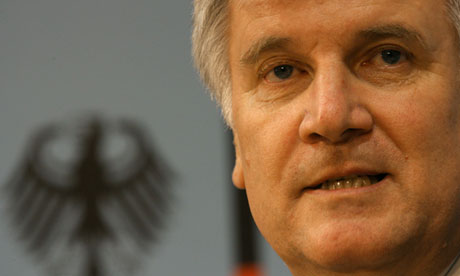
Horst Seehofer, the prime minister of Bavaria, has called for Gustl Mollath's case to be reopened. Photograph: Pawel Kopczynski/Reuters


A German man committed to a high-security psychiatric hospital after being accused of fabricating a story of money-laundering activities at a major bank is to have his case reviewed after evidence has emerged proving the validity of his claims.
In a plot worthy of a crime blockbuster, Gustl Mollath, 56, was submitted to the secure unit of a psychiatric hospital seven years ago after court experts diagnosed him with paranoid personality disorder following his claims that staff at the Hypo Vereinsbank (HVB) – including his wife, then an assets consultant at HVB – had been illegally smuggling large sums of money into Switzerland.
Mollath was tried in 2006 after his ex-wife accused him of causing her physical harm. He denied the charges, claiming she was trying to sully his name in the light of the evidence he allegedly had against her. He was admitted to the clinic, where he has remained against his will ever since.
But recent evidence brought to the attention of state prosecutors shows that money-laundering activities were indeed practiced over several years by members of staff at the Munich-based bank, the sixth-largest private financial institute in Germany, as detailed in an internal audit report carried out by the bank in 2003. The report, which has now been posted online, detailed illegal activities including money-laundering and aiding tax evasion. A number of employees, including Mollath's wife, were subsequently sacked following the bank's investigation.
The "Mollath affair", as it has been dubbed by the German media, has taken on such political dimensions that it now threatens to bring down the government of Bavaria. Under the weight of public and political pressure Horst Seehofer, the prime minister of the rich southern state and a member of the Christian Social Union (CSU) – the sister party to Angela Merkel's Christian Democrats – has now called for the case to be reopened, amid charges that Mollath was possibly the victim of a gross miscarriage of justice.
"The judiciary would be well-advised to reassess the case," Seehofer said this week. "I want them to concentrate on the question of whether everything has been done correctly."
His justice minister, Beate Merk, who has refused repeated calls to resign, said she had no doubt the case had been carried out "by the book and quite correctly".
Mollath has been inundated with public support in the form of thousands of letters and internet posts, many comparing his fight to that of David versus Goliath. He said he was delighted that what he called the "murky business of the bank" is now emerging, 10 years after he first made his claims.
"This is precisely what I wanted to achieve all along," he told the Süddeutsche Zeitung, which brought the audit report to light earlier this month. In an interview in his sparsely furnished room in Bayreuth's hospital for psychiatry, he pointed out the irony that he had suffered the fate he had repeatedly warned his wife she would face, telling her: 'Please be careful. One day you will end up in handcuffs and then you'll be banged up for a few years'", he said.
Asked whether it felt any responsibility towards Mollath, a spokeswoman for HVB told the Guardian: "We don't recognise any connection between the results of our audit report and either the criminal trial or the commitment of Mr Mollath."
Asked why the bank kept the report to itself and did not approach the authorities, the spokeswoman added: "In 2003 HVB initiated extensive investigations via internal audits in response to information provided by Mr Mollath on transactions that had taken place a long time before … It was determined that employees had acted contrary to their instructions regarding Swiss banking transactions".
But while the findings, it said, had resulted in sackings, the audit "did not produce sufficient evidence indicating criminal conduct … that would have made a criminal charge seem appropriate".


Sunday, 2 December 2012

My speech at Aristotle University of Thessaloniki, Greece, 19 Nov. 2012


Here are the announcement & link to the speech I gave at Aristotle University in Thessaloniki (my speech begins at 1:22:30):

-------------------------------------------------------------------------------------------------------------------


ARISTOTLE UNIVERSITY OF THESSALONIKI

The University Initiative for Policy Alternative outlets invites you to an event on:


"Alternative policies for managing the crisis"

http://www.auth.gr/video/15117


Speakers: 

Leonidas Vatikiotis, Economist, Journalist 
John Theodosius, Professor of Economics, University of Aberdeen, 

Lefteris Tsoulfidis, Associate Professor, Department of Economics, University of Macedonia, 

Jonathan Sugarman, Financial commentator, former Risk Manager of UniCredit Bank Ireland


Contact Info
authacademicinitiative@gmail.com
About the event
Dates: 
Monday, the 19th November, 2012 - 6pm to 9pm
Venue: 
KE.D.E.A Building (Auditorium A, ground floor)
Event organization
University Initiative for Policy Alternative outlets
Submitted on 15/11/2012 @ 14:35


Sunday, 18 November 2012

Dr. Brian Hillery, Mr. Matthew Elderfield, care for a probity test?

David Malone raised some interesting points in his Golem XIV blog last Friday: David learned his craft as a documentary maker at the BBC science department, where he worked for 9 years, ending up on Horizon. Since then he has made films for Channel 4, BBC2 and more recently BBC4. Some of his documentaries are available on YouTube.

================================================


Jonathan Sugarman versus UniCredit – an update

by Golem XIV on NOVEMBER 16, 2012 in LATEST

WhistleblowerIRL, AKA Jonathan Sugarman continues to fight UniCredit. One rather impecunious man fighting a trillion euro bank. But Jonathan is nothing if not …well I leave you to fill in the blank.

The update comes via a very good 12th Nov. editorial in Village Magazine in Ireland, “Blowing the whistle so hard it hurts”.

"In December 2010 a risk-manager in the Irish unit of UniCredit, Italy’s largest bank, described in Village how in 2007 the Financial Regulator failed to intervene after he first alleged he falsified liquidity-ratio  figures. The risk-manager maintained he was specifically warned by senior personnel at the Irish subsidiary not to report the matter to the Financial Regulator
Jonathan Sugarman blew the whistle on the massive repeated breaches. This magazine received aggressive threats from McCann FitzGerald solicitors on behalf of UniCredit not to publish the information."

To the credit of its publisher and owner, Michael Smith, the magazine has stood by the story and refused to be cowed.  I recommend reading the whole story. You can follow any further developments at Jonathan’s blog.

One thing to keep in mind when you read the story. The Irish financial regulator, Matthew Elderfield, was recruited, fresh from his earlier success at being one of the three Heads of Department at the British regulator, the FSA who were overseeing…Northern Rock. Mr Elderfield, along with his two fellow Heads of Department, was specifically criticised in the official report into Northern Rock. His supporters, namely the people in Ireland who hired him, will say he was only in that job three months when Northern Rock imploded. What, and that makes his silence all right?! So if an aircraft inspector had only been at his job for three months it would be fine for him to say nothing about an unsafe aircraft? That would be OK would it?

That would be a double standard if one could call it any sort of standard at all.

So I have my doubts about Mr Elderfield. Which are made worse when you consider some of the people above him and the world view they seem to have.  You see there is an old guard In Ireland – as there is in most countries, mine definitely included – that has not moved on and has zero intention of ever moving on. Here for example you can watch Mr Bertie Ahern back in 2007 saying how he can’t understand why people who talk down the wonders of Ireland’s no-touch economy don’t just kill themselves.  Mr Ahern was never Elderfield’s boss. I mention Ahern simply as an example of a world-view which is still there, defended by people still in positions of power.

One such old guard is Mr Elderfield’s boss, Dr Brian Hillery.  Dr Hillery was appointed to be a Director of the Central Bank of Ireland which incorporates the Financial Regulators Office of Ireland, in May 2008. Before his appointment to be guardian of financial probity in Dublin, he was the Chairman of …UniCredit Bank Ireland at the precise time Mr Sugarman was there trying to report those financial ‘problems’ to the financial regulator (who at the time was Mr Elderfields disgeraced predecessor, Mr Patrick Neary). So definitely no conflict of interests there. Obviously.

I feel absolutely sure that Dr Hillery would be very comfortable with, and would fully support, a rigorous investigation of UniCredits’ behaviour and its attention to the law, and that the pressure brought to bear upon Village magazine when it chose to write about Unicredit and its breaches of liquidity are purely coincidental. I feel equally sure Mr Elderfield would feel fully supported in any investigation he undertook , which combined with his own proven track record of razor sharp and iron fisted regulatory zeal must make the Irish people feel warm all over. In good hands – as the priest/radio one DJ said to the boy.

Oh and it might be worth keeping in mind that  Dr Hillery was also Chairman of Independent Newspapers in Ireland. Whose papers have not covered this story with any great … regularity shall we say.


http://www.youtube.com/watch?v=hfjGSfuSQpA

http://www.villagemagazine.ie/index.php/2012/11/blowing-the-whistle-so-hard-it-hurts/

 A reader's Comment:

C. Flower November 17, 2012 at 11:51 am # 
Great post, and also choice comments from the Dork from Cork. Jonathan Sugarman thought his job was risk management, when in reality it seems his employers wanted him to be rubber stamping illegal breaches of liquidity. Bank bosses knew their banks had gone over a cliff and the whole strategy was to buy time to consolidate their personal wealth and pass debt over to the public. The role of insiders like Hillery in this is essential – in part in that they give an aura of probity, respectability, and officialdom (Hillery being the son of a past President of Ireland) to a rogue operation – and also in that they tie “officialdom” and the political class into a backstream of financial benefits. Hillery is discussed further here –


Tuesday, 6 November 2012

Blowing the whistle so hard it hurts - Village magazine's latest editorial article

Nearly all Ireland’s banks breached liquidity requirements, leading to the lack of liquidity that the government provided a guarantee against, and which ultimately emerged as the insolvency that bankrupted the country and immiserated the next generation. Failures at the Regulator and in the Central Bank contributed as much as anything to this bankruptcy. The public is entitled to know that these well-paid and cosseted functionaries have learnt lessons and are now demonstrating the most stringent and scrupulous standards. It’s interesting then to know how they treated the most important whistleblower in Irish banking history.
In December 2010 a risk-manager in the Irish unit of UniCredit, Italy’s largest bank, described in Villagehow in 2007 the Financial Regulator failed to intervene after he first alleged he falsified liquidity-ratio  figures. The risk-manager maintained he was specifically warned by senior personnel at the Irish subsidiary not to report the matter to the Financial Regulator, even though sound banking depends on maintenance of these ‘liquidity ratios’ which are crucial to the ability of the company to deal with losses of confidence. The liquidity ratio should be no less than 90 per cent. At UniCredit it was calculated at an extraordinary 50 per cent. A ratio of 89 per cent would in normal circumstances be deemed problematic. In banking terms this is like paying with a two-euro note.
Jonathan Sugarman blew the whistle on the massive repeated breaches. This magazine received aggressive threats from McCann FitzGerald solicitors on behalf of UniCredit not to publish the information.
The new ‘poster-boy’ regulator, Matthew Elderfield,  stated in response to questions from the Sunday Business Post, and the Süddeutsche Zeitung, a respected German newspaper, about statements made in the Seanad by David Norris which backed up Sugarman’s account, that “our records do not match the description of events given by Senator Norris nor did we receive what might be described as a ‘whistleblower’ letter.  We can, however, confirm that an overnight liquidity breach was reported by an institution around the time in question. The matter was followed up with the institution and rectified to the satisfaction of the Financial Regulator at the time”.
For someone in whom so much public good-will has been invested, this is remarkably disingenuous, though certainly true. The Regulator’s records presumably do not match Senator Norris’s because its agents didn’t look hard enough or take a proper record; and the Regulator did not receive a whistleblower letter as the letter came from UniCredit itself, which limited its declaration to one overnight breach. Notably, nothing the Regulator said undermined the credibility of the risk-manager.
Largely as a result of the story in Village which named the bank, the Central Bank said it would conduct a review of the case and invited parties with information to share it: “if any party has specific information  they wish to draw to our attention in this matter it will be treated on a confidential basis”. Things dragged out but in February 2012 the risk-manager attended a meeting with the office of the regulator.  Scandalously the bank’s offer of ‘confidentiality’ was revealed under pressure to be spurious when it insisted that it wouldn’t be enough to shield Sugarman against self-incrimination in the event his own actions constituted criminal activity.  The Central Bank insisted it must forward information to the DPP if there were evidence of a crime. This highlights the need for whistleblower legislation to protect insiders who tell their truth – and particularly that legislation should be retrospective, so it would embrace cases like Mr Sugarman’s.
In June, the Central bank informed Mr Sugarman, without giving reasons, that the matter was closed and only after Mark Keenan raised the affair anew in the Irish Independent in September, did the Central Bank finally furnished minutes of the meeting it had had with Mr Sugarman. This was six months after the original meeting.  For some reason Mr Keenan is no longer writing on these issues in the Irish Independent.
Matthew Elderfield and his office are doing no favours to EU banking regulators, or to the world’s banking and economic system, in being   disingenuous about liquidity breaches at the elusive UniCredit. If there is a desire not to frighten the horses just while our bailout is under review, it is misplaced.  The lesson of recent history for this country is scrupulousness and openness.
There is a general official view that Ireland’s ethical delinquencies are in the past. Deviant planning stopped when the tribunals started; and bad banking regulation stopped with the demise of Pat Neary. In fact this is not so with planning as we have seen with the kicking to touch of John Gormley’s reviews of planning in six counties. Scrutiny of what happened in banking has been limited to two innocuous reports by Patrick Honohan, Peter Nyberg and Klaus Regling. These notably failed to attribute blame or to deal with how liquidity ratios were breached all over financial Dublin with no comment from the usual over-paid auditors, and no sanction.
Inconveniently for a country that has started to see corruption and regulation in black (then) and white (now) terms, the general view may not reflect the reality. Without proper scrutiny we cannot be sure either way.
Like bad planning, bank under-regulation was a manifestation of this country’s ineradicable tendency to pander to vested interests and to the short term. It is time we got to the bottom of what happened in Irish banking.  Scrupulous investigation of Mr Sugarman’s allegations would be a symbolic good start.

http://www.villagemagazine.ie/index.php/2012/11/blowing-the-whistle-so-hard-it-hurts/